Introduction
Across Nigeria, schools are increasingly adopting digital exams. From CBT centers to computer-based assessments, it appears as though the education system is evolving. But beneath the surface, a critical question remains: Are we truly going digital… or just changing how we test?
The Shift We Celebrate
There is no doubt that digital exams bring certain advantages:
- Faster processing of results
- Reduced examination malpractice (to some extent)
- Standardized testing environments
On paper, this looks like progress.
And in isolation, it is. But education does not happen during exams. It happens long before that.
The Reality in Classrooms
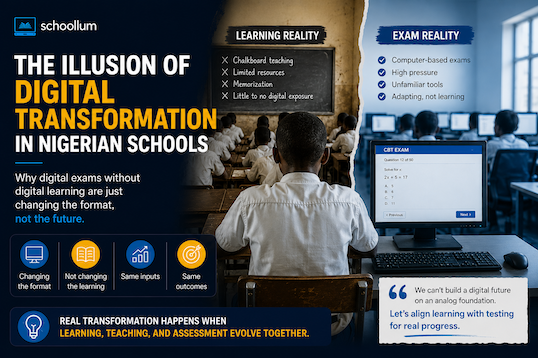
In many schools today, the daily learning experience remains unchanged:
- Overcrowded classrooms
- Chalkboard-based teaching
- Heavy reliance on note-taking and memorization
- Limited or no access to digital tools
For most students, interaction with a computer happens only once: During exams.
What Are We Really Testing?
When students who rarely use computers are suddenly required to write exams digitally, we need to be honest about what is being measured. It is not digital literacy. It is not deep understanding. It is not problem-solving ability.
What we are measuring instead is: Adaptation under pressure. The ability to navigate an unfamiliar system in a high-stakes environment. That is not the same as learning.
The Mismatch Problem
This creates a fundamental disconnect:
- Learning is analog
- Assessment is digital
And when input and evaluation do not align, outcomes do not improve.
We end up with:
Same knowledge gaps.
Same weaknesses.
Same results.
Just presented on a different platform.
Why This Matters
Education is not just about passing exams. It is about building capability. If students are not exposed to digital tools during learning:
- They cannot develop digital confidence
- They cannot explore beyond static content
- They cannot build real-world problem-solving skills
In a world where digital interaction is becoming the norm, this gap becomes more dangerous over time.
What Should Change?
Fixing this does not require massive, unrealistic investments. It requires alignment. Here are practical steps schools can begin with:
1. Integrate Digital Learning into Daily Teaching
Even limited devices can be shared in structured rotations.
2. Train Teachers, Not Just Students
Digital transformation starts with teaching methods, not devices.
3. Focus on Interaction, Not Just Access
Students must use technology, not just see it.
4. Start Small, But Stay Consistent
A few hours of weekly digital engagement is better than none.
A Mindset Shift
We need to move away from thinking:
“Digital exams mean digital education.”
They do not. Real transformation happens when:
Learning, teaching, and assessment evolve together.
Conclusion
Nigeria is not wrong to adopt digital exams. But stopping there creates an illusion of progress. Because changing the format of assessment without changing the process of learning does not improve outcomes. It only changes how those outcomes are delivered.